
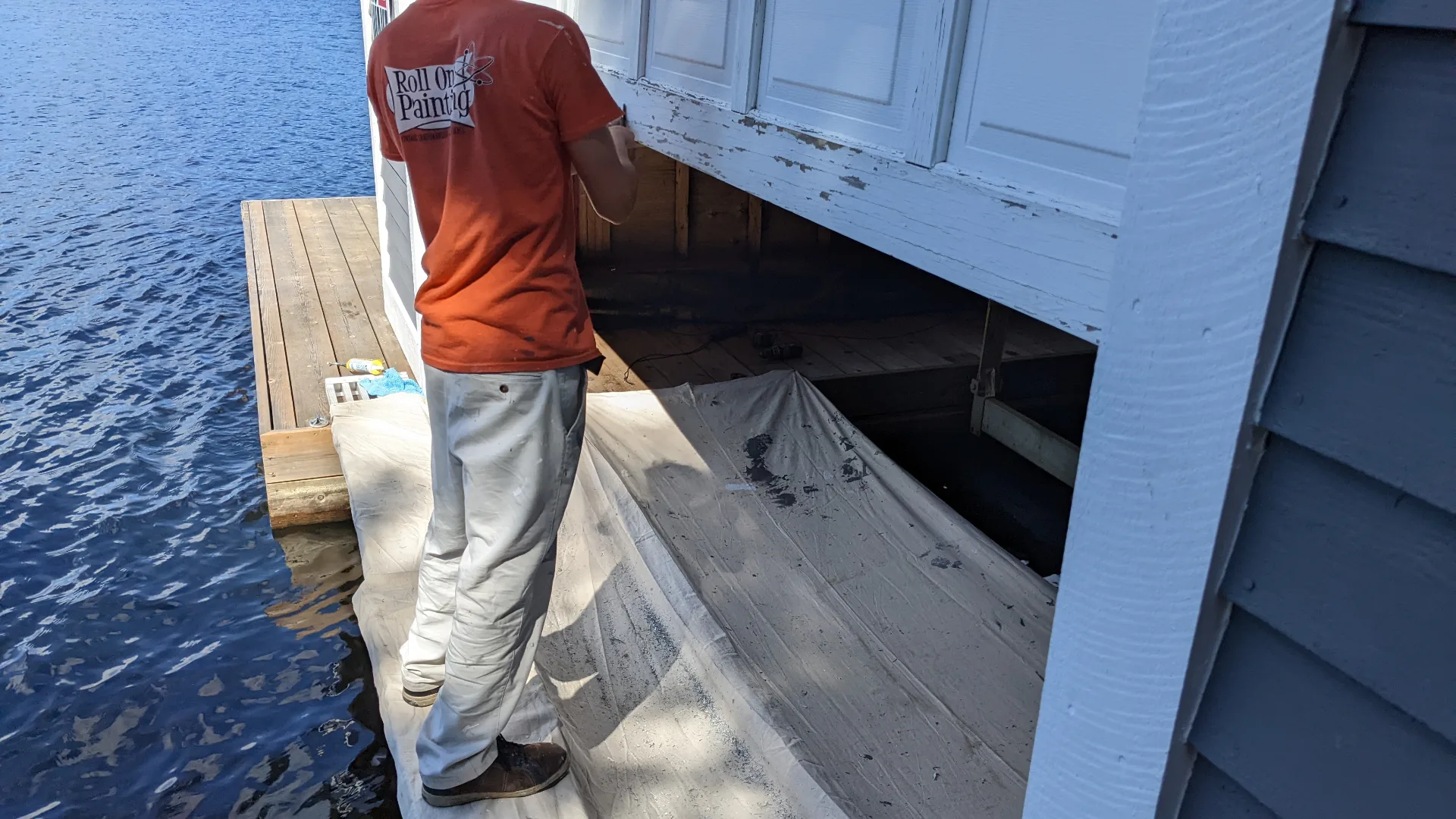
Flood-Damaged Boathouses & Docks in Muskoka: How to Protect Your Wood After the Water Recedes
If you've been watching the water rise this spring — and if you're a lakefront property owner in Huntsville, Bracebridge, or anywhere along the Muskoka River watershed — you already know how bad it's been.
The Ministry of Natural Resources issued a Flood Warning for most of Muskoka that remained in effect through the first week of May 2026. Water levels surpassed those seen in previous years, exceeding 200 mm in certain areas — levels not seen since 2019, which was widely considered a once-in-a-hundred-year event. To see it approach those levels again so soon is genuinely heartbreaking for everyone who calls this region home.
We've been hearing from property owners across the lakes this week — worried about their docks, their boathouses, their decks. Some have had structures partially submerged for weeks. The water is starting to pull back now. And when it does, the work begins.
This post is for you. Not a sales pitch — just straight talk about what flood-soaked wood needs, in the right order, so you don't make it worse.
First: What Extended Submersion Actually Does to Wood
Wood and water have always had a complicated relationship in Muskoka. But there's a big difference between rain, humidity, and lake splash — and sitting underwater for two, three, or four weeks.
When wood is fully or partially submerged for an extended period:
- It becomes completely saturated, right through to the core fibres — not just surface wet
- The cellular structure weakens, making it more vulnerable to splitting and checking as it dries
- Tannins and natural resins leach out, reducing the wood's natural rot resistance
- Mould, mildew, and algae colonize quickly, especially in the warm May air that follows a cold-water flood
- Existing coatings fail — floodwater gets under coatings and breaks the bond at the substrate
The wood you're looking at when the water drops is not the same wood that went in. It needs to be treated accordingly.
Step One: Do Nothing Until the Wood Has Properly Dried
This is the hardest part for property owners who want to fix things fast. We understand the impulse. But applying any coating — stain, paint, sealer, or primer — to wood that is still wet or saturated will fail. Full stop.
What "properly dry" means:
- Surface dry is not enough. You need the core moisture content to drop below 15–18% before any coating is applied
- In May Muskoka conditions, that typically takes 4–8 weeks minimum after the water recedes, depending on sun exposure, air circulation, and wood species
- Pressure-treated lumber holds moisture longer than cedar or pine
- Shaded north-facing dock sections will take longer than sun-exposed decking
What you can do right now while waiting:
- Remove any standing debris, leaves, and silt from surfaces
- Open up any enclosed sections of the boathouse to maximize airflow
- Do not power wash yet — that drives more water in and can damage softened wood fibres
- Photograph everything for insurance purposes before you touch it
Step Two: Assess What You're Working With
Once the wood begins to dry, you'll start to see what the flood actually did. Walk the structure carefully and look for:
Structural concerns (call a contractor or engineer first):
- Significant checking or splitting in load-bearing posts or beams
- Soft spots underfoot — a sign of rot that may have been accelerated by submersion
- Fastener corrosion causing boards to lift or pop
Surface damage (paintable/stainable):
- Peeling or bubbling paint or stain — any coating that was applied over now-saturated wood
- Grey or black discolouration from mould and mildew
- White mineral deposits (efflorescence) on concrete foundations or block
- Tannin bleed-through — brown or rust-coloured staining from the wood itself
The surface damage is fixable. That's where we come in.
Step Three: Proper Prep — This Is Where Most Flood Recovery Goes Wrong
We say it on every project and we'll say it again here: the prep is everything. With flood-damaged wood, cutting corners on prep doesn't just reduce the lifespan of the finish — it can accelerate the rot process you're trying to stop.
The correct prep sequence for flood-affected boathouse wood:
- Mould and mildew treatment first. Before any sanding or stripping, treat all affected surfaces with a proper wood cleaner and mildewcide solution. This kills the biological growth at the surface and prevents it from being ground deeper into the wood by sanding. Let it dwell and rinse thoroughly.
- Stripping existing failed coatings. Any coating that has peeled, bubbled, or lost adhesion must come off completely. Do not try to coat over it. Use appropriate strippers for paint or stain, then scrape, and follow with a thorough cleaning. Partial adhesion is not good enough — floodwater will have found the weak points.
- Wood brightener application. After stripping and cleaning, apply a quality wood brightener (oxalic acid-based). This neutralizes the tannin staining, removes grey oxidation, and opens the wood grain to accept new product. Flood-damaged wood typically benefits from two applications. This step is often skipped on standard projects — after a flood, it is non-negotiable.
- Sanding. Once clean and bright, sand with 60–80 grit to open the grain and ensure the new coating penetrates rather than sitting on the surface. Pay particular attention to areas where old coatings were removed — those surfaces need to be scuffed back to clean, bare wood. Skip this step and your new finish will peel within one season.
- Final moisture check. Before any product goes on, check moisture content with a pin-type moisture meter. You are looking for 15–18% or below. If the reading is higher, wait. No exceptions.
Step Four: Choosing the Right Product for Flood-Recovered Wood
Not all coatings are created equal, and flood-recovered wood has specific needs.
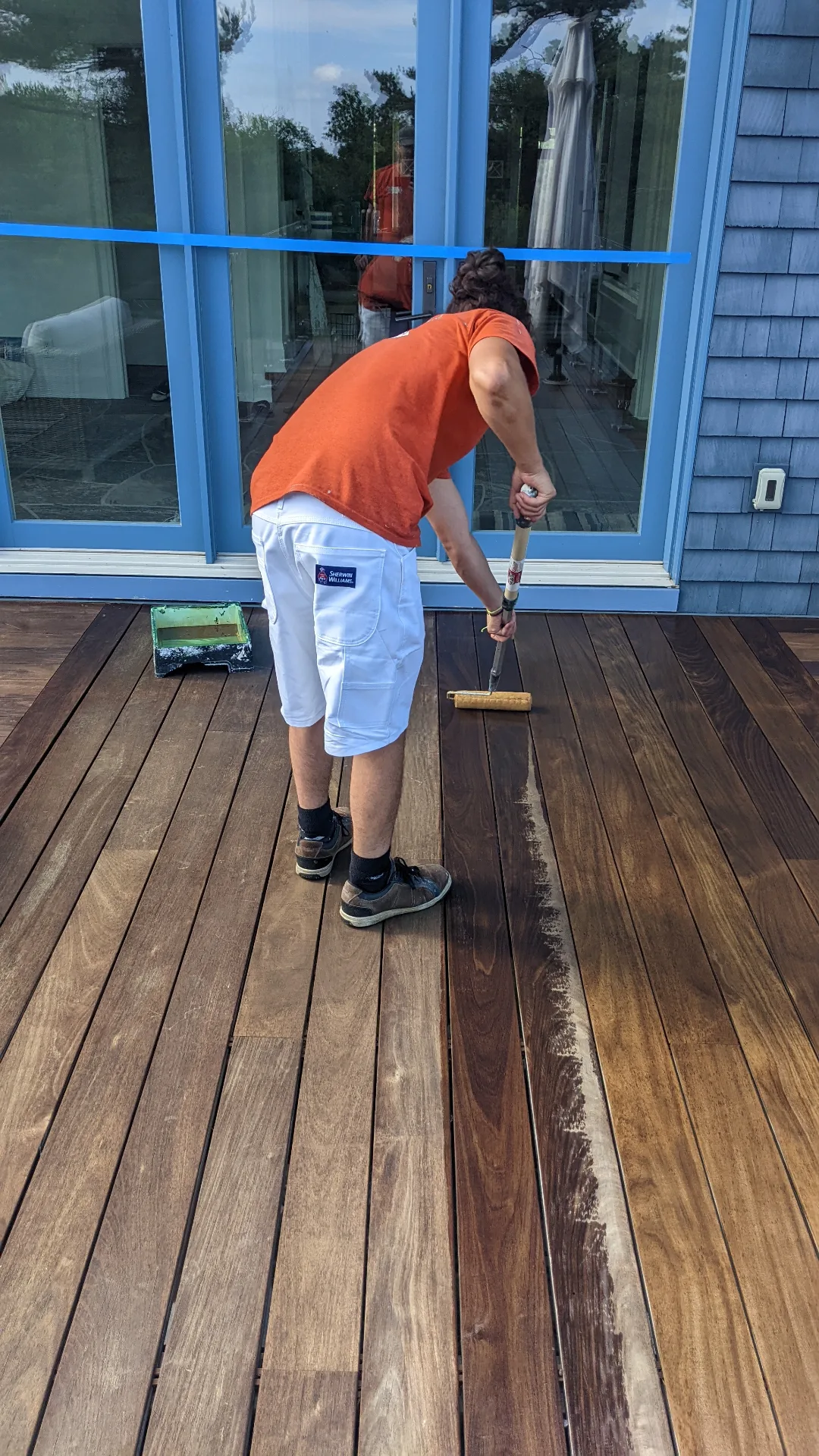
For docks, dock decking, and horizontal exterior surfaces: A penetrating, breathable stain system is the right call — not a film-forming coating. We use Sansin Dec for horizontal surfaces like dock decking: it penetrates deep into the wood fibre, bonds at a molecular level, and — critically — allows the wood to continue breathing and releasing residual moisture. A film-forming coating applied over wood that is still releasing moisture will trap that moisture and fail. Sansin's waterborne, penetrating system avoids that entirely.
For boathouse siding and vertical surfaces: Sansin SDF or an exterior paint system, depending on the original finish and aesthetic. For painted boathouses, a quality exterior primer is mandatory on any bare wood before topcoats are applied — especially on flood-damaged surfaces where the previous coating has been compromised.
For long-term wood protection after recovery: Once the wood has been properly treated and the stain or paint has cured, GoNano Wood Saver is worth serious consideration. GoNano's nanotechnology penetrates the wood at a microscopic level to create a hydrophobic barrier — meaning water beads off the surface rather than soaking in. Given what your dock just went through, making it dramatically more water-resistant going forward is a smart investment. It also helps prevent the moss and algae growth that floods leave behind as a parting gift.
Step Five: Timing Your Project Correctly
This is a patience game, and we know that's frustrating when you're looking at a waterlogged structure every morning.
Our honest timeline recommendation for Muskoka flood recovery projects in 2026:
- May: Assess, document, clean, treat mould, strip failed coatings. Let the wood dry.
- June: Moisture check, wood brightening, sanding. Begin coating if readings are acceptable.
- Late June through July: Ideal window for exterior wood staining and painting once wood is properly dry and temperatures are consistent.
Do not rush this. A coat of stain applied in late May to wood that is still wet will cost you twice — once for the failed application and once to redo it properly.
Frequently Asked Questions
My boathouse paint is peeling after the flood. Can I just paint over it?
No. Peeling paint means the bond between the coating and the substrate has been broken by water. You need to strip what's failing, clean and prep the bare wood, prime with a quality exterior primer, and then topcoat. Painting over peeling paint after a flood will peel again within weeks.
How long does flood-soaked dock wood need to dry before I can stain it?
In Muskoka spring conditions — cool nights, limited sun on some dock sections — plan for a minimum of 4–8 weeks after the water drops before any stain application. Use a moisture meter to confirm you're at or below 18% before proceeding. Early June is typically the earliest realistic window for most properties affected by the 2026 flooding.
Is there anything I can do right now while the wood is still wet?
Yes. Clean off debris and silt, treat visible mould with a mildewcide solution, and document everything with photos. Do not power wash wet, softened wood. Do not apply any coating. Get a moisture meter so you can track the drying progress.
My dock was treated with stain last summer. Do I still need to strip it?
Inspect it carefully. If the stain is still adhering well with no bubbling, peeling, or loss of bond, you may only need to clean, brighten, and recoat once the wood is dry. If there is any lifting or adhesion failure, those areas need to be fully stripped. The flood will have found every weak point in the existing finish.
Should I be worried about mould inside the boathouse structure?
Yes, particularly on interior wood surfaces that were submerged or heavily splashed and are now in a warm, enclosed environment. Treat all affected surfaces with a proper mildewcide before closing the structure up. Ensure maximum ventilation through May and June. If you see black mould on structural timbers, have it assessed — surface mould and deep rot mould require different responses.
We're Your Neighbours. We Know What This Feels Like.
We've been part of Muskoka since 1999. We've watched the lakes through good springs and brutal ones. The low-lying area near Huntsville's Main Street bridge and the Town Dock went underwater this spring, and major closures included Town Dock Park, Hunter's Bay Trail, and Avery Beach. We've had clients calling us all week.
This is hard. And the recovery is going to take time. But when you're ready — when the wood is dry and the conditions are right — doing this properly will protect your investment for years to come.
Roll On Painting serves lakefront properties across Huntsville, Bracebridge, Port Carling, Lake of Bays, and 38 communities across Muskoka, Almaguin, Parry Sound, Georgian Bay and Orillia. Chad Gilchrist and his crew have 25+ years of experience with exactly this kind of exterior wood work, in exactly these conditions.
When you're ready for your free assessment, reach out at 705-787-1401 or book through roll-onpainting.com/contact. We'll come to you, assess the damage, and give you a straight answer about what needs to happen — in the right order.